
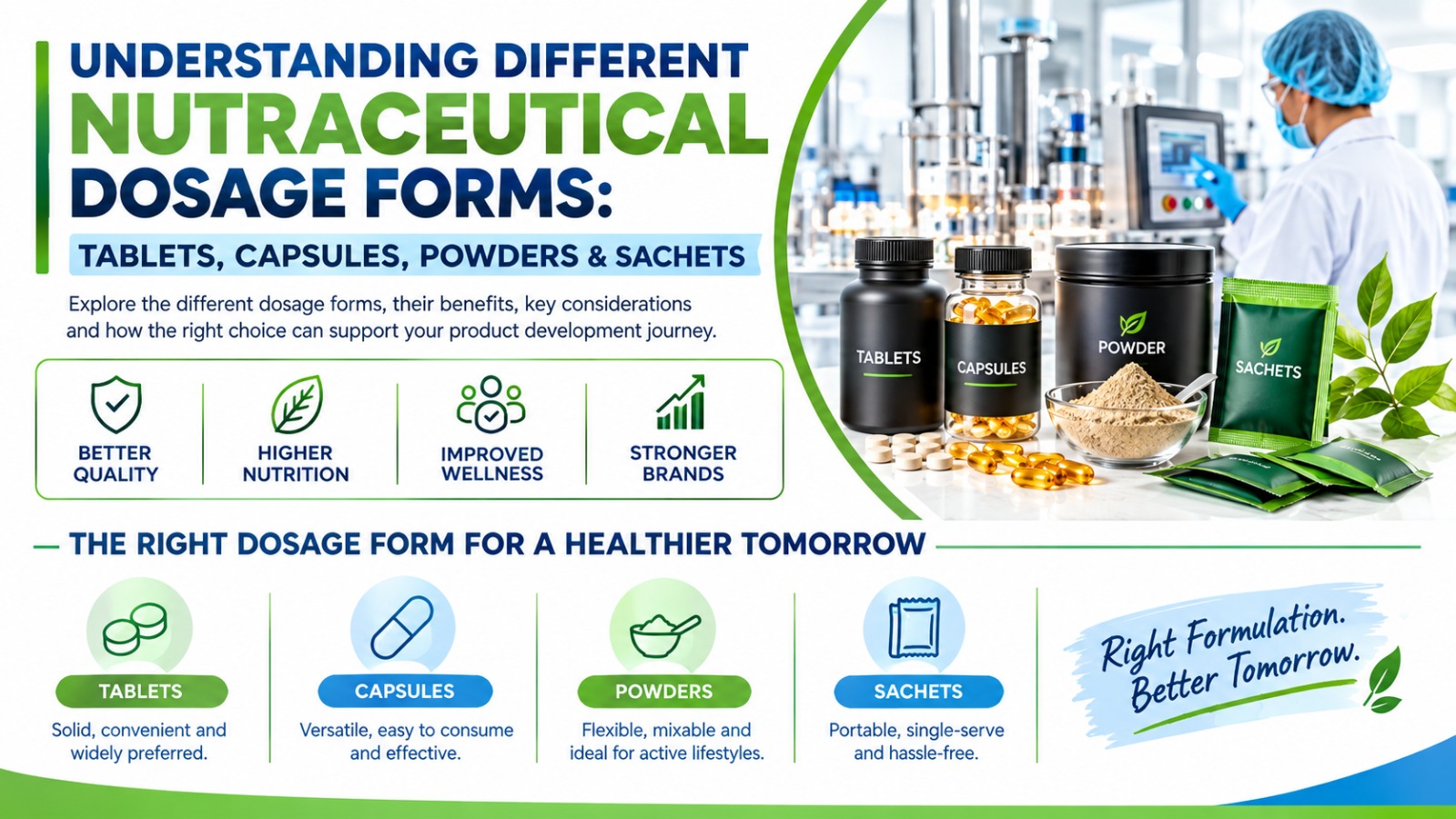
The nutraceutical industry has witnessed a tremendous rise in the past decade, with numerous companies developing products that focus on nutritional, wellness, herbal, vitamin, mineral, sports nutrition, and functional nutrition segments. As brands enter this competitive space, they are faced with an important decision of identifying the nutraceutical dosage form for their products.
Some of the popular dosage forms include tablets, capsules, powders, sachets, and formulations. Each form has its characteristics and may suit specific product concepts, formulations, serving requirements, packaging, and other attributes.
For companies that intend to launch a new range of dietary or nutraceutical supplements, it is important to understand the differences and benefits of each dosage form. Working with an experienced Nutraceutical Manufacturer in India can also help brands understand their formulation and manufacturing requirements before finalizing the product.
In this blog, we will discuss the different nutraceutical dosage forms, factors to consider while selecting them, and how Tanishq Life Care can help in product development and manufacturing.
What Are Nutraceutical Dosage Forms?
A dosage form refers to the form in which a nutraceutical product is prepared or presented to the consumer.
Different nutraceutical products, such as dietary supplements, vitamins, minerals, herbal products, sports nutrition, functional food, wellness products, and other formulations, can be developed in various dosage forms. Based on the product category and requirements, nutraceuticals can be developed as:
- Tablets
- Capsules
- Powders
- Sachets
- Herbal supplements
- Vitamin and mineral products
- Sports nutrition products
- Wellness products
- Functional nutrition products
The choice of dosage form is an essential consideration when it comes to product development because the formulation, serving requirements, packaging, manufacturing process, and other aspects must be compatible with the selected form.
Why Is It Important to Choose the Right Dosage Form?
The choice of dosage form influences numerous factors, including the manufacturing process, packaging, presentation, and consumer experience. For instance, the manufacturing process and packaging requirements for a tablet formulation will be different from those of a powder-based product. Similarly, when it comes to powders, the packaging will also vary for sachets and capsules.
It is essential to keep this in mind while finalizing the manufacturing requirements for your nutraceutical product.
Apart from the appearance and presentation, the following factors can also help you finalize the best dosage form for your nutraceutical product:
- Product formulation
- Ingredient characteristics
- Serving requirements
- Target audience
- Product category
- Packaging requirements
- Manufacturing requirements
- Quality requirements
- Product positioning
- Future product expansion
A reliable Nutraceutical Manufacturer in India can help you evaluate the abovementioned factors to understand the best product formulation and manufacturing requirements.
Overview of Nutraceutical Dosage Forms
1. Nutraceutical Tablets
Tablets are solid dosage forms that are commonly used for different nutraceutical products. The nutraceutical formulation is converted into tablets, which are then offered as the final product to the consumer.
Tablets are a preferred choice for developing vitamin and mineral supplements, as well as other wellness products, depending on the formulation and manufacturing requirements. These are some of the advantages of tablets:
- Solid dosage form
- Easy to present
- Can be offered in various packaging options
- Suitable for most formulations
- Easy to process
The decision to go with tablets will depend on the formulation, ingredients, manufacturing requirements, and other considerations.
2. Nutraceutical Capsules
Similar to tablets, capsules are also a solid dosage form for various nutraceutical formulations.
This dosage form is ideal for developing different nutraceutical products, including dietary supplements, herbal formulations, vitamin and mineral supplements, and other wellness products. Brands considering capsules as their preferred dosage form can benefit in the following ways:
- Solid dosage form
- Easy to present
- Alternative to tablets
- Suitable for various formulations
- Offering options for different packaging
The decision to go with capsules will depend on the product formulation, ingredients, serving requirements, product positioning, and manufacturing requirements.
3. Nutraceutical Powders
Powders are a flexible and convenient option for developing different nutraceutical products. These are commonly used for sports nutrition and functional food products that require a powder-based serving form.
Depending on the formulation and requirements, the powders can also be developed as mixable variants, which can be mixed with water or other suitable liquids. Here are some of the benefits of using powders as a dosage form for nutraceutical products:
- Flexible and convenient option
- Can be mixed with liquids
- Suitable for sports nutrition
- Can be developed as functional nutrition products
- Can be offered in various packaging variants
- Can be used to develop diverse product concepts
It is important to keep in mind that not all formulations are compatible with the powder-based dosage form. The abovementioned benefits can be finalized after considering the product formulation, ingredients, serving requirements, packaging, and other applicable factors.
4. Nutraceutical Sachets
Sachets are primarily used as a single-dose or individual serving packaging for various nutraceutical products, which is why they are commonly used for powder-based products. Sachets can be considered for developing nutraceutical products that come in a powder-based formulation and require a convenient and compact presentation.
Here are the reasons why sachets are a popular choice among nutraceutical manufacturers:
- Individual serving option
- Easy to carry
- Compact packaging variant
- Can be distributed as single-dose options
- Suitable for certain powder-based products
The decision to go with sachets as the preferred dosage form will depend on the product formulation, serving requirements, packaging material, product characteristics, and other requirements.
Factors to Consider While Finalizing a Dosage Form
When it comes to nutraceutical products, the choice of a dosage form cannot be finalized without considering the abovementioned factors. The following points will give you a brief idea about the considerations that must be taken into account before finalizing the most suitable option for your nutraceutical product:
1. Product Formulation
The formulation is one of the most critical factors that must be taken into account while selecting a dosage form.
Depending on the formulation and ingredients, some of the dosage forms may be more appropriate than others. It is essential to understand the formulation before finalizing the most suitable option for your product.
2. Ingredient Characteristics
The characteristics of the formulation ingredients also play a significant role in determining the most suitable option.
The formulation development process must take into account the ingredient verification, material check, formulation controls, quality checks, and other considerations. A product development expert can help you review the formulation requirements to finalize the most suitable option for your nutraceutical product.
3. Target Audience
When it comes to nutraceutical products, the target audience plays a significant role in determining almost all product development considerations, including the dosage form.
Certain product concepts will be more appropriate for specific audiences, such as tablets and capsules for vitamins and minerals and powders for sports nutrition. It is essential to understand the target audience and their requirements before finalizing the most suitable option.
4. Serving Requirements
It is essential to consider the serving requirements before finalizing the most suitable option.
The requirement for individual dosing will influence the decision to go with sachets for certain powder-based products. The abovementioned considerations must be taken into account while reviewing the product formulation and finalizing the dosage form.
5. Packaging Requirements
The choice of a dosage form is closely linked to the packaging requirements since different packaging options are available for different forms.
Depending on the product category, the suitable packaging options can include bottles, jars, boxes, pouches, sachets, blister packs, and other variants. It is essential to select the most suitable option based on the product formulation, serving requirements, and other considerations. Simultaneously, the packaging must also comply with the relevant labelling and regulatory requirements.
6. Product Positioning
The product positioning will also influence the choice of the dosage form. As suggested by the name, product positioning refers to how the product will be presented to the target audience, including the language, imagery, presentation, and other elements.
It is essential to consider how the product will be positioned and what presentation will appeal to the target audience. Based on this, the most suitable option must be finalized.
7. Future Expansion
When considering the choice of a dosage form, it is also essential to keep in mind the future product expansion plans. It will be more cost-effective and convenient to work with a manufacturer that offers comprehensive services, including the development of tablets, capsules, powders, sachets, herbal supplements, vitamins, minerals, sports nutrition products, and other formulations.
Overview: From Product Concept to Finalized Dosage Form
As suggested by the name, product development is a complex process that requires extensive research, planning, and execution. From the initial concept to the final product, there are several crucial steps that must be taken into account:
Step 1: Product Concept
A product concept refers to the initial idea of a product, including the category, intended purpose, target audience, and other relevant considerations.
Step 2: Formulation Development
Based on the product concept and requirements, a formulation is developed, keeping in mind the ingredient selection and other factors.
Step 3: Dosage Form
The dosage form that will be most suitable for the product formulation must be finalized. The decision to go with tablets, capsules, powders, sachets, or other options will depend on the formulation requirements, ingredients, target audience, serving requirements, packaging, and other considerations.
Step 4: Sample Development
Based on the finalized product formulation and requirements, samples can be developed for review and approval.
Step 5: Manufacturing
After the samples have been approved, the finalized product can be manufactured as per the product development requirements.
Step 6: Quality Checks
Depending on the product category, quality checks can include ingredient verification, formulation checks, in-process checks, finished product testing, batch record review, traceability, and other relevant considerations.
Step 7: Packaging & Labeling
The finalized product will be packaged as per the relevant requirements.
Step 8: Delivery
Depending on the product requirements, delivery timelines can also be finalized to ensure seamless supply chain management.
Importance of R&D in Nutraceutical Product Development
As mentioned earlier, product development is a complex process, and brands must invest considerable resources in research and development (R&D) to ensure that they can manufacture high-quality products that appeal to their target audience.
A competent R&D team can help in developing nutraceutical products as per the target audience, product category, formulation, ingredients, dosage form, and other considerations. The R&D process is crucial for nutraceutical manufacturers that intend to offer innovative products to their clients instead of relying on conventional formulation and manufacturing methods.
Therefore, it is essential to consider the R&D capabilities of a manufacturer before finalizing them for your product development and manufacturing needs.
Quality Control in Nutraceutical Manufacturing
When it comes to nutraceutical products, it is essential to ensure that appropriate quality control (QC) measures are taken at every step of the product development and manufacturing process to ensure that the final product is up to industry standards and is fit for consumption.
A competent QC team plays a crucial role in reviewing every aspect, including the raw materials, formulation, manufacturing process, laboratory testing, batch record review, traceability, and other relevant considerations.
By collaborating with an experienced manufacturer, you can ensure that your product development and manufacturing process have systematic QC procedures in place to maintain the quality of your nutraceutical product.
Packaging and Labeling Considerations
As discussed earlier, the choice of a dosage form is directly linked to the packaging requirements. Apart from being an essential consideration for product development, packaging also plays a crucial role in building the brand image, ensuring product protection, and supporting supply chain management.
The choice of a packaging option will depend on the product category, dosage form, serving requirements, and other relevant factors. For instance, tablets and capsules can be offered in a bottle, jar, box, or blister pack, while powders can be offered in pouches or sachets, depending on the formulation and other requirements.
It is also essential to ensure that the product labeling and packaging are compliant with the relevant regulations for the target market.
Why Choose Tanishq Life Care for Nutraceutical Manufacturing?
The selection of the most competent manufacturer is crucial for every nutraceutical product development initiative since it can have a significant impact on almost all aspects of the project, ranging from formulation and manufacturing to packaging and quality control.
Tanishq Life Care is a reputed nutraceutical manufacturer that specializes in nutraceutical product development and manufacturing solutions for health and wellness products. The company offers comprehensive solutions to help brands launch their nutraceutical products, including formulation development, product development, nutraceutical manufacturing, and packaging solutions.
Tanishq Life Care has a team of experts that understand all aspects of nutraceutical product development and manufacturing. For brands that intend to launch nutraceutical products in the form of tablets, capsules, powders, sachets, herbal supplements, vitamins, minerals, sports nutrition, and other formulations, the company can offer end-to-end solutions.
By collaborating with Tanishq Life Care, you can benefit from the extensive product development experience of the company to create nutraceutical products that incorporate the most suitable formulation, dosage form, and packaging to meet the requirements of your target audience.
When it comes to nutraceutical product development, it is essential to keep in mind that the choice of a dosage form will be determined by the product formulation and other requirements. A competent manufacturer can help you review the relevant considerations and finalize the most suitable option.
Tanishq Life Care has extensive experience in nutraceutical manufacturing, which can help brands launch their products with confidence.
What Should You Ask a Nutraceutical Manufacturer?
Before finalizing a manufacturer for your product development and manufacturing needs, it is essential to have a clear understanding of your requirements.
Some of the crucial questions that you must ask a nutraceutical manufacturer include:
- What dosage form is suitable for my product formulation?
- What ingredients can I use for my nutraceutical product?
- What product development support do you offer?
- What quality control procedures do you follow?
- What packaging options do you offer?
- What is the minimum order quantity?
- What are your manufacturing timelines?
- What tests do you conduct?
- What labelling requirements do you follow?
- Can you support my future product expansion needs?
By asking the abovementioned questions, you will have a clear idea about the services offered by the manufacturer, their capabilities, requirements, and other crucial factors.
Frequently Asked Questions About Nutraceutical Dosage Forms
What are the different types of nutraceutical dosage forms?
Some of the most common nutraceutical dosage forms include tablets, capsules, powders, and sachets. Other product types can include herbal supplements, vitamins and minerals, sports nutrition products, wellness products, and functional nutrition products.
Are capsules better than tablets?
It depends on the formulation, ingredients, serving requirements, product concept, packaging, and other relevant factors.
Are nutraceutical powders suitable for sports nutrition products?
It depends on the formulation, ingredients, serving requirements, and other relevant factors.
What are nutraceutical sachets used for?
Sachets can be used for individual or single-dose packing of various nutraceutical products, including those in powder form.
How can I choose the most suitable dosage form for my nutraceutical product?
The choice of the dosage form will depend on the formulation, ingredients, serving requirements, target audience, product positioning, packaging, manufacturing process, and other relevant factors.
Do I need to consider different packaging options for different dosage forms?
Yes, different dosage forms will require different packaging options. For instance, tablets and capsules can be offered in a bottle, jar, box, or blister pack, while powders can be offered in a pouch or sachet, depending on the formulation and other considerations.
Why is R&D essential for nutraceutical products?
R&D plays a crucial role in formulation development and product optimization. It can help manufacturers finalize the most suitable ingredients, product category, formulation, dosage form, target audience, and other factors.
What should I look for in a nutraceutical manufacturer?
While finalizing a nutraceutical manufacturer, it is essential to consider their capabilities, quality control procedures, certifications, compliance with relevant regulations, R&D capabilities, product range, manufacturing capabilities, packaging options, MOQ, delivery timelines, communication, and other relevant factors.
Conclusion
Choosing the most suitable dosage form is an essential step in nutraceutical product development since it can influence almost all other considerations, ranging from formulation and manufacturing to packaging and quality control. Tablets, capsules, powders, sachets, herbal supplements, vitamins, minerals, sports nutrition, and other nutraceutical products can be developed based on the formulation and other product-specific factors.
However, the choice of a dosage form cannot be finalized based on popularity or other irrelevant factors. Instead, nutraceutical manufacturers must consider the formulation, ingredients, serving requirements, target audience, packaging, quality control, manufacturing, and other factors.
A competent Nutraceutical Manufacturer in India can help you finalize the most suitable option based on your product formulation and requirements.
Tanishq Life Care is a reputed nutraceutical manufacturer that offers end-to-end solutions for nutraceutical product development and manufacturing. By collaborating with the company, you can benefit from their extensive product development experience to create nutraceutical products in the most appropriate dosage form for your target audience.
When developing a new nutraceutical product in the form of tablets, capsules, powders, sachets, herbal supplements, vitamins, minerals, sports nutrition, and other formulations, it is essential to consider product development and manufacturing requirements to ensure that the final product meets your expectations.